

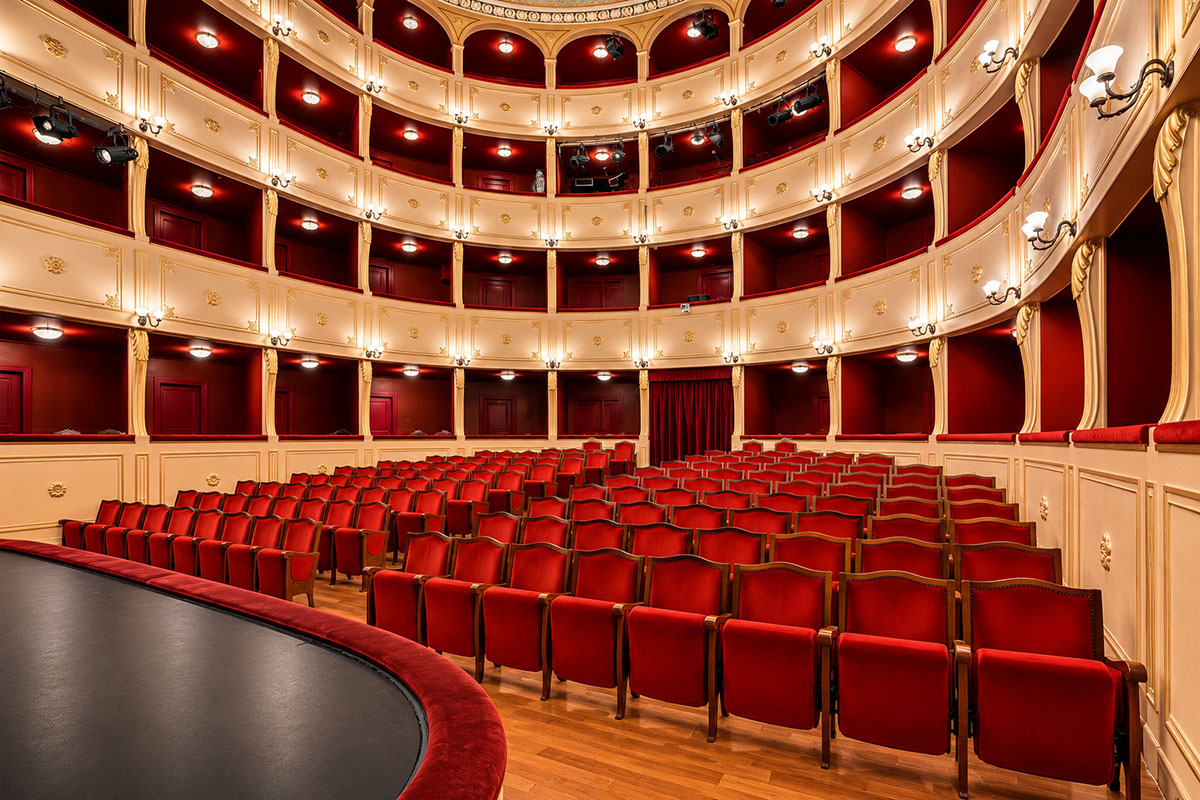
Just a few minutes’ walk from Miaouli Square, the Apollon Theater is one of the most interesting historic buildings in Hermoupolis. Its relatively simple exterior gives little indication of the decorated auditorium inside, with its curved balconies, painted ceiling and intimate atmosphere.
Built in 1864, the theater dates back to a period when Hermoupolis was one of Greece’s most important commercial centres. Its history reflects the city’s rapid growth, its cultural ambitions and the efforts of the local community to preserve an important part of its heritage.
A theater built during Hermoupolis' golden age
During the 19th century, Hermoupolis developed into a major centre of shipping, trade and industry. Refugees from Chios, Psara and other parts of the Aegean had settled on Syros, helping establish a prosperous city with an active social and cultural life.
Theater performances were already taking place in Hermoupolis by 1828, often in temporary venues such as warehouses, clubs and cafés. As the city grew, the need for a permanent theater became increasingly clear.
Construction began in 1862, following a decision by the municipality. The building was designed by Pietro Sampo, the Italian architect working for the city at the time.
The Apollon Theater officially opened on 20 April 1864, with a performance of Giuseppe Verdi’s opera Rigoletto.
The opening was an important event for Hermoupolis. In just a few decades, a city founded by refugees had developed the resources and cultural life needed to support its own opera theater.
The connection with La Scala in Milan
The Apollon Theater is often described as a smaller version of La Scala in Milan. While the two buildings share certain architectural influences, the theater in Hermoupolis isn’t an exact copy.
Pietro Sampo drew inspiration from several Italian theaters, including La Scala, the San Carlo Theater in Naples, the Teatro della Pergola in Florence and the theater in Castelfranco.
The building’s exterior is relatively restrained, especially compared with some of the grand neoclassical buildings elsewhere in Hermoupolis. Inside, however, the traditional horseshoe-shaped auditorium is surrounded by tiers of balconies and decorative details.
The relatively small dimensions bring the audience close to the stage, creating a different experience from that of a large opera house.
It’s this contrast between the understated exterior and the carefully decorated interior that makes the theater particularly interesting to visit.
From decline to restoration
The Apollon Theater followed the changing fortunes of Hermoupolis. As the city’s commercial importance gradually declined, the theater faced increasing difficulties. During the Second World War, it was used for cinema screenings by the occupying forces, and it continued to operate mainly as a cinema after the war.
In 1953, the building closed after being considered unsafe for performances.
An attempt at renovation during the 1970s remained unfinished and significantly altered the original interior.
For years, local theatrical groups continued to campaign for its restoration. Despite the building’s poor condition, amateur performers kept using the space and helped maintain public interest in its future.
A major restoration project finally began during the 1990s, with the aim of recovering the theater’s historic character and making it suitable for modern performances.
The Apollon Theater reopened on 17 July 2000, with a performance of The Godson, an operetta by Greek composer Theophrastos Sakellaridis.
The restoration marked a new chapter for a building that had been part of Hermoupolis’ cultural life for more than a century.
What can you see inside?
The main auditorium is the highlight of a visit to the Apollon Theater. Its curved balconies, decorative details and painted ceiling give visitors an impression of the 19th-century theatrical architecture that inspired its design.
Much of the decoration visible today was recreated during the restoration rather than preserved from the original building. The ceiling and wall paintings are the work of artist Dimitris Fortsas.
On the upper floor, a small exhibition presents the theater’s history through old photographs, posters, programmes, manuscripts and other objects.
You don’t need to attend a performance to appreciate the building. A daytime visit, when available, offers the opportunity to explore the auditorium and learn more about its past.
The Apollon Theater today
More than 160 years after its opening, the Apollon Theater remains an active part of Hermoupolis’ cultural life.
It hosts theatrical productions, concerts, festivals and other events, with performances by both local and visiting artists.
Among the events associated with the theater are the International Festival of the Aegean and the International Classical Music Festival of the Cyclades, alongside other cultural programmes held throughout the year.
If your visit coincides with a performance, attending an event is a good way to experience the auditorium as it was intended to be used.
Otherwise, the theater is still worth including in a walk around the historic centre.
Visiting Apollon Theater in Syros
The theater is located on Vardaka Square, just a short walk from Miaouli Square and the Town Hall.
Its location makes it easy to combine with other landmarks in central Hermoupolis. From here, you can continue towards the Church of Saint Nicholas and the Vaporia district, or return to the streets around Miaouli Square for coffee or lunch.
A few practical things are worth knowing before your visit:
- Opening hours: Visiting hours may vary depending on the season, rehearsals and scheduled performances. Check the official website before going.
- Museum: The small exhibition on the upper floor provides additional information about the theater’s history.
- Performances: The programme includes theatrical productions, concerts and cultural events throughout the year.
- Getting there: The theater is within walking distance of the port and central Hermoupolis. Parking nearby can be difficult, so it’s usually easier to explore this part of the city on foot.
For current visiting information and upcoming events, see the official Apollon Theater website.
The Apollon Theater offers more than a glimpse of 19th-century architecture. It helps explain how Hermoupolis developed into a city with a cultural life that extended well beyond its commercial activities.
And unlike many historic buildings, it continues to fulfil its original purpose, welcoming audiences to performances more than a century and a half after its opening.
Find the perfect vehicle for your trip.
Cars
Let’s hit the road!
Scooters
Feel the breeze